
How to Price a Painting Job: Square-Foot Rates vs. Pricing the Time

Ask how to price a painting job and someone will give you a square-foot number. It's simple, and some experienced painters use it well. For a newer painter, it's also one of the fastest ways to underbid.
The trouble with square-foot pricing
Our co-founder sees new painters get burned by it. "You read 'charge a few dollars a square foot and you'll do fine,' and then a picky client wants extra prep and a few custom colors." You finish, work out the hours afterward, and "realize you barely paid yourself for two weeks. It's gut-wrenching to see how badly you underbid."
A square-foot rate hides what actually drives the job: prep, coats, color changes, cutting in, ceiling height, furniture, and how particular the client is. Two rooms with the same square footage can take very different amounts of time.
His rule of thumb: "A flat square-foot rate only works once you have a lot of your own job data behind it. Until then, price the time."
It's gut-wrenching to see how badly you underbid.
How to price the time
Pricing the time means estimating the hours for each surface, then turning those hours into a price.
- Measure each surface. Area for walls and ceilings, length for trim, a count for doors and windows.
- Apply a production rate, meaning how much of that surface one painter finishes in an hour. Labor hours = quantity × coats ÷ production rate.
- Add setup and prep as their own lines: moving furniture, masking, patching, sanding, priming.
- Multiply hours by your labor rate. It should cover wages, payroll taxes, insurance and overhead, not just what you pay the painter.
- Add materials. Gallons = area × coats ÷ spread rate, rounded up, times your paint cost. Add sundries like tape, plastic and caulk.
- Add your markup and check the margin before you send.
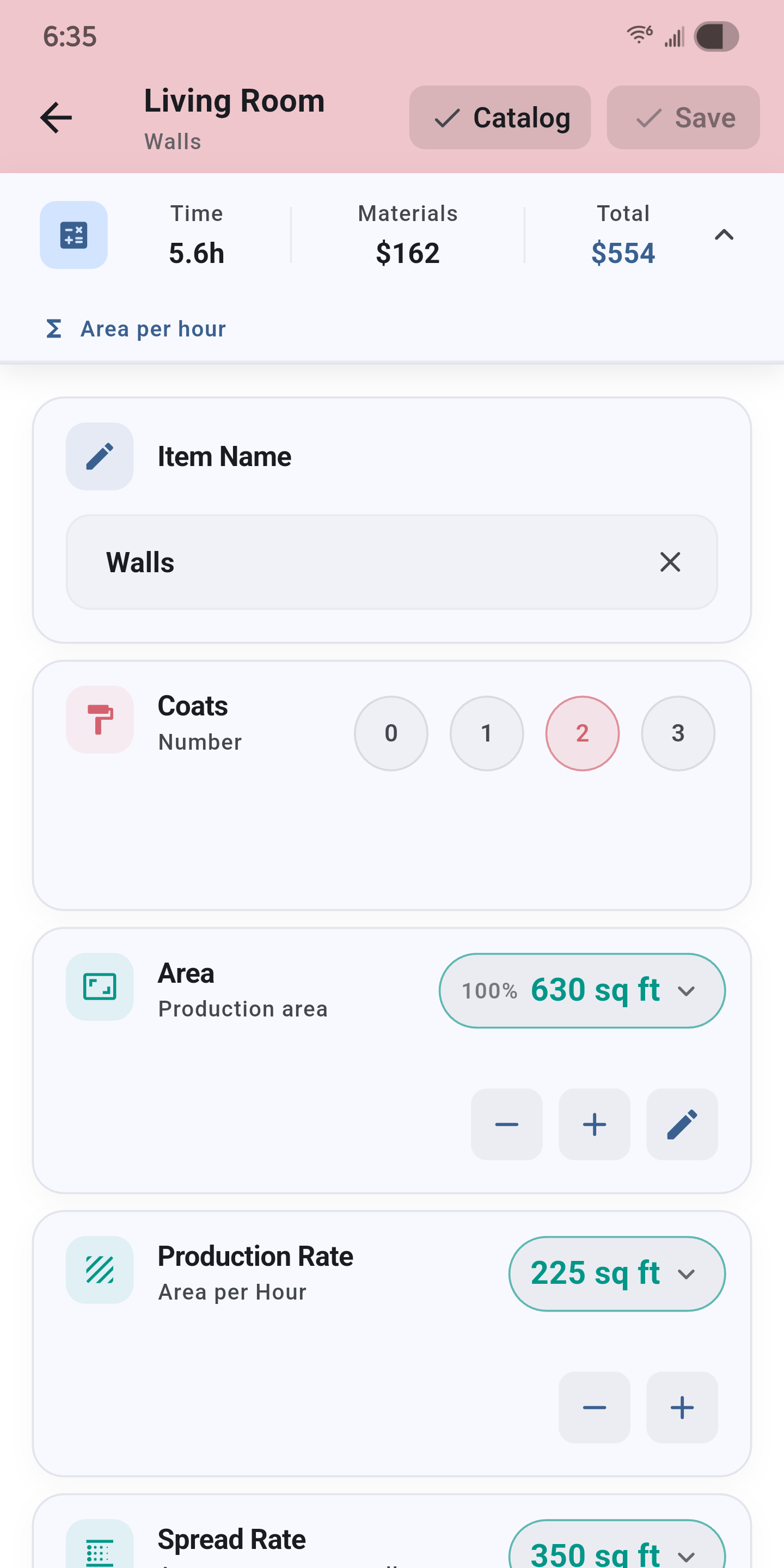
Production rates are personal. They depend on your crew, your tools and the work you take on. Compare actual hours to estimated hours on a few jobs and adjust your rates from what you find.
Other ways to price, and when they fit
Most painters mix methods on the same job. Our co-founder adds up labor hours on most of his jobs, but "everyone calculates the same kind of item differently." One painter prices doors by the hour, another per door, another as part of the room.
- Flat price per room or item works for work you've done so many times you know the number, like a standard bedroom or a front door. Keep an eye on the hours behind it.
- Time and materials fits repairs, extra prep, and anything you can't see until you open it up.
- Square foot works once your own job history tells you what a square foot really costs you.
Markup is not margin
Markup is profit as a share of your cost. Margin is profit as a share of the price. On a job that costs you $1,000, a 25% markup adds $250 and makes the price $1,250. That $250 is 25% of the cost but only 20% of the price.
Markup 25% = $250 profit ÷ $1,000 cost
Margin 20% = $250 profit ÷ $1,250 price
The same job always shows a smaller margin than markup, so a painter who thinks in markup can believe the job pays better than it does. Check gross profit and margin, not just the total, before the estimate goes out.
No app will tell you what to charge
You still need to know your costs. What software can do is the arithmetic and the paperwork, so your judgment is the only thing left to get right.
EstimateSync prices each item the way you price it: production rates for walls, ceilings, trim, doors and windows, a flat price for a room or item, or time and materials, all on one estimate. Change a rate and labor, gallons and price update right away. The pricing screen shows time and labor, materials, final price, gross profit and margin before you send.